


Description
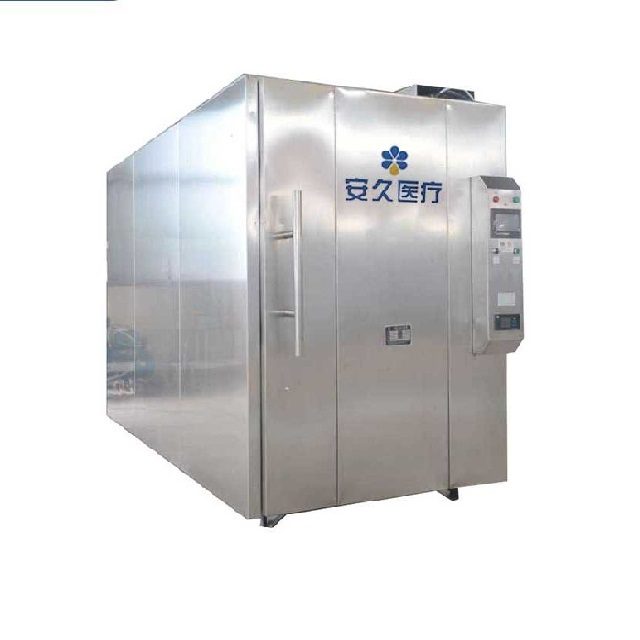
The EO gas sterilizer consists of three parts: the sterilization chamber, auxiliary equipment (vacuum system, electric heating system, humidification system, EO system, EO vaporization system, pneumatic system, and residue removal system), and the overall control system.
Sterilization Chamber of the EO Sterilizer
1. The sterilization chamber includes a stainless steel liner, door device, and door seal. The chamber material needs to meet the requirements for vacuum and pressure. The EO gas sterilizer uses electric heating mode.
2. Liner material: SUS304 stainless steel, actual thickness 6mm.
3. Temperature sensation of the sterilization chamber: no obvious temperature sensation outside throughout the sterilization cycle.
4. Insulation: 5cm thick rock wool with good insulation performance during normal operation. No obvious temperature sensation appears during the sterilization process.
5. Shell plate: SUS304 stainless steel drawing = 1.2mm.
6. Sterilization door: uses a single door structure, pneumatic single door seal. (In case of failure during use, it is necessary to ensure locking and sealing at all times). Sealing method: external air cushion with silicone rubber.
7. Monitoring instruments: automatic real-time monitoring of pressure, humidity, and temperature monitoring devices, accuracy and error ± 1%.
8. Motor: 380V 50Hz
Vacuum System:
1. Vacuum pre-discharge and EO gas sterilizer must be performed in the sterilization chamber using a vacuum pump.
2. Vacuum can be pulsed or graded.
3. Vacuum pipes use SUS304 material.
4. Pressure range: -70kPa to + 60kPa, hold pressure for 60 minutes, leakage rate <0.1kpa / minute
5. Vacuum speed: atmospheric pressure to -15kPa ≤6 minutes, -50kPa ≤30 minutes, -70kPa ≤40 minutes
Heating and Temperature Cycle:
1. Electric heating is adopted. The six surfaces of the sterilization chamber are heated by electric heating belts. The temperature sensor inside the cabinet > 8m, with at least 2 pieces, has the advantages of uniform and stable heating, power saving, simple design and structure, and more convenient use.
2. Real-time temperature monitoring device, exceeding the set temperature alarm, temperature control range inside the cabinet <65 ℃, accuracy ± 3 ℃
Humidification System:
1. Equipped with an automatic water vapor generator and corresponding piping components (the partial pressure of water vapor for humidification should not exceed 50KPa). At least 2 humidity sensors
2. Separate water vapor injection pipe and filter (sterilization level).
3. Steam pipes are made of SUS304.
4. Automatic real-time monitoring, exceeding the set humidity alarm, humidity error inside the cabinet: ± 5% RH
Ethylene Oxide Vaporization:
1. The EO gasifier has an independent atomization pipe, gasification and filter, which can precisely control the temperature of the EO gas entering the sterilization chamber to ensure sufficient ethylene oxide gasification and ensure sterilization effectiveness. (The filtration rate of particles > 0.3 µm is at least 99.5% and easy to disassemble) and sensing and heating and control system.
2. The EO injection port is equipped with an automatic injection device and an independent temperature sensor is set at the inlet to control the EO temperature (control accuracy ± 1).
3. The amount of EO is controlled by the weighing method, with an accuracy of 0.05kg.
4. There must be a pressure sensor in the sterilizer to measure the EO concentration during operation and the circulation system.
5. The sterilization process ensures that the pressure is maintained at the set pressure ± 5KPa and an independent humidity control device is used to ensure that the gaseous EO does not exceed 70 ℃
Residue Removal System:
1. After the sterilizer is discharged, the air is filtered through a filter (with a filtration rate of at least 99.5% for particles > 0.3µm and easy to disassemble) and then enters the sterilization chamber.
2. According to the sterilization procedure, filtered air can be introduced to atmospheric pressure, and then the sterilization chamber can be vacuumed, 0-99 times as defined.
3 According to the sterilization procedure, ethylene oxide gas is removed by the continuous flow of filtered air passing through the sterilization chamber.
4. After the sterilization process is completed, the residual EO gas in the cabinet must be extracted by a water ring vacuum pump, and completely mixed and dissolved with water.
5. The dissolved wastewater is contained in the waste liquid storage tank and discharged into the wastewater pipe.
Pneumatic System:
1. During the sterilization process, all control valves and doors must be opened and closed. The sealing and unsealing of the door must be done by pneumatic components such as solenoid valves, polyurethane air ducts, and aluminum alloy air cylinders.
2. Piping fittings and components such as valves, interfaces, and filters must meet the requirements of YY0503-2016.
Main Control System:
1. Use industrial special PLC to automatically control the entire working process and has storage and printing functions. Real-time implementation and printing of display monitoring data such as temperature, humidity, and pressure.
2. It has short-circuit protection and power-off memory functions, and can continue to operate before power-off after power-on
Ethylene Oxide Sterilization Process and Principles
Ethylene Oxide Sterilization Equipment
Currently, ethylene oxide is widely used for sterilization of medical devices. Ethylene oxide is a common sterilant. It is a toxic, flammable, and explosive gas with an ether-like odor. The relative density is 0.884 at 4 ° C, the boiling point is 10.8 ° C, and its density is 1.52g / cm3. At room temperature, it easily evaporates into a gas, which can explode when the concentration is too high.
Application Range of EO Gas Sterilizers
Ethylene oxide does not damage sterilized items and has strong penetration, so most items that are not suitable for sterilization by conventional methods can be sterilized and disinfected by ethylene oxide.
For example: electronic instruments, optical instruments, medical equipment, fur, cotton, chemical fibers, plastic products, endoscopes, blood filtration devices, and disposable medical supplies.
Ethylene oxide is one of the most important low-temperature sterilization methods.
Advantages
- Can kill all microorganisms, including spores, Mycobacterium tuberculosis, bacteria, viruses, fungi, etc.
- Sterilized items can be packaged and sealed, and can be kept sterile before use
- Relatively speaking, ethylene oxide does not corrode plastics, metals, and rubber, and will not make items yellow and brittle
- It can penetrate items with irregular shapes, complex structures, and those that are not easy to penetrate (such as long and thin tubes)
- It can be used to sterilize items that cannot be immersed in sterilants, dry heat, pressure, steam, and other chemical gas sterilization.
>>> Buy EO gas here
Instructions
- Because ethylene oxide is flammable, explosive, and toxic to humans, it must be carried out in a sealed ethylene oxide sterilizer.
EO Sterilizers and Their Applications
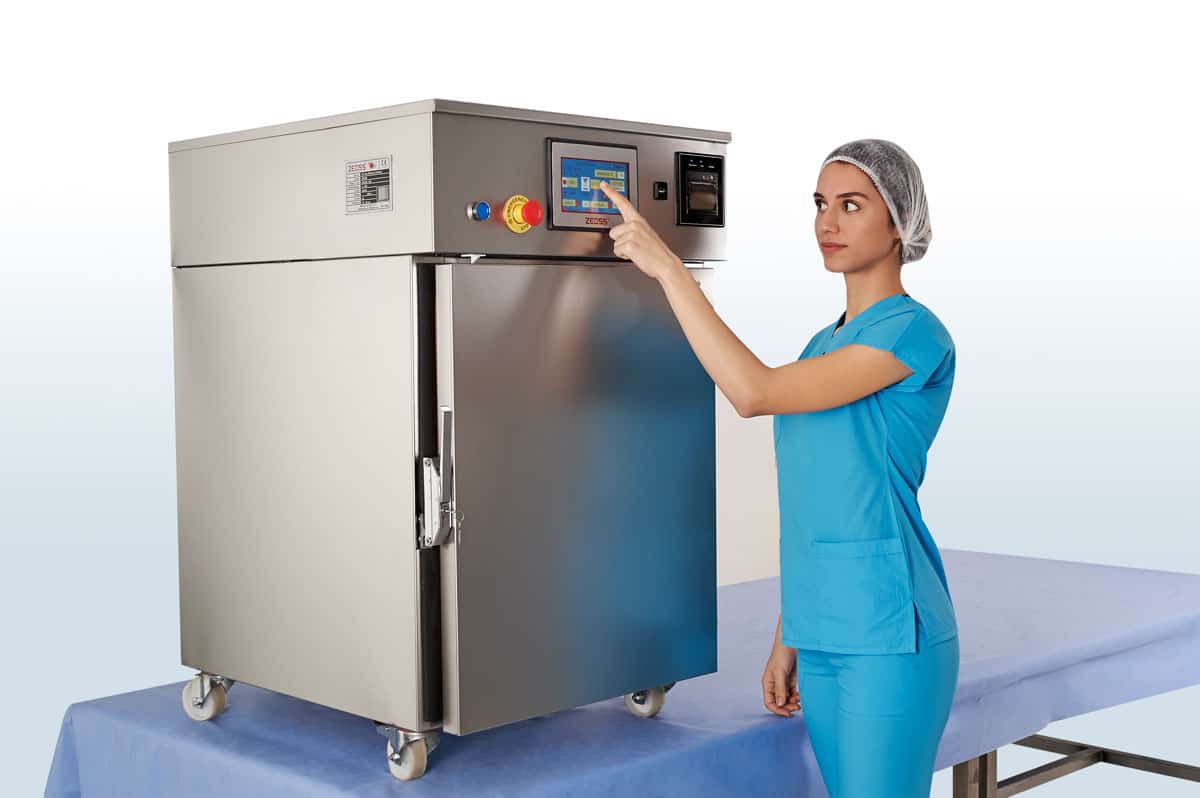
Currently, there are many types of EO gas sterilizers used. Large ones have dozens of cubic meters, medium ones from 1-10 cubic meters, and small ones from a few tenths to 1 cubic meter. They have different uses.
Large EO Gas Sterilizer:

- Large EO gas sterilizers are usually used to sterilize a large number of processed items, the dosage is 0.8kg/m³ ~ 1.2kg/m³, and it operates at 55~60℃ for 6 hours.
Medium EO Gas Sterilizer:

- Medium EO gas sterilizers are usually used to sterilize disposable medical supplies.
- This sterilizer is complete and highly automated.
- It can use pure ethylene oxide or a mixture of ethylene oxide and carbon dioxide.
- The general requirements for sterilization are: concentration, 800 mg/L ~ 1000mg/L; temperature 55℃~60℃; relative humidity 60% ~ 80%; action time 6 hours.
- Vacuuming is required after the sterilization process is completed. Sterilized items are usually sealed in plastic films that can be penetrated by ethylene oxide. If there is an air filter membrane on the small packaging, the sterilization effect is better
Small EO Gas Sterilizer:

- Small eo gas sterilizers are mainly used in medical and health departments to process a small number of equipment and medical supplies.
- Small EO gas sterilizers can use 100% pure ethylene oxide or a mixture of ethylene oxide and carbon dioxide.
- This is a type of sterilizer with a relatively high degree of automation. It can automatically vacuum, add medicine, automatically adjust temperature and relative humidity, and can also automatically control the sterilization time.
- The requirements for medium and small ethylene oxide sterilizers are: good pressure resistance and airtightness, must be able to withstand a hydraulic test of 1.25 times the working pressure, without deformation and leakage, can be vacuumed to 53.3 kPa or more;
- Accurate dosage, good heat preservation performance, can adjust the temperature and relative humidity in the sterilizer;
- After washing with outside air after sterilization, the inlet air passes through a high-efficiency filter, which can filter out more than 99.6% of particles ≥0.3um; residual ethylene oxide is harmlessly treated, and the ethylene oxide remaining in sterilized items must be less than 15.2mg / m; the concentration of ethylene oxide in the sterilization environment must be less than 2mg / m.
Preparation and Packaging of Items Before Sterilization
Precautions when sterilizing with an EO gas sterilizer
- Items to be sterilized must be thoroughly cleaned. Be careful not to use physiological saline solution.
- There should be no water droplets or too much water on sterilized items to avoid diluting and hydrolyzing ethylene oxide.
- Ethylene oxide can be used to sterilize most medical supplies, but it is not suitable for sterilizing food, liquids, lubricants, talc powder, and animal feed.
- Suitable packaging materials for ethylene oxide sterilization are paper, composite blood filtration paper, cloth, non-woven fabric, hard containers with ventilation holes, polyethylene, etc.;
- Packaging materials that cannot be used for ethylene oxide sterilization are metal foil, Polyvinyl chloride, cellophane, nylon, polyester, polyvinylidene chloride, non-permeable polypropylene.
- Changes in packaging materials need to be verified to ensure the reliability of sterilized items.
Storage of Sterilized Items
- There must be a gap above, below, left, and right of the items placed in the sterilization cabinet (sterilized items must not touch the cabinet wall)
- Items must be placed in metal mesh baskets or metal mesh racks; the amount of goods must not exceed 80% of the total volume in the cabinet
Sterilization
- It must be carried out according to the operating instructions of the ethylene oxide sterilizer manufacturer; depending on the type of items to be sterilized, packaging, load capacity, and method, select appropriate sterilization parameters
Relationship between concentration, temperature, and sterilization time:
- Within a certain range, increasing the temperature and increasing the concentration can shorten the sterilization time.
- When using the ethylene oxide sterilization method, temperature, concentration, and time parameters must be reasonably selected.
Control the relative humidity of the sterilization environment and the water content of items:
- The microbial content in water and the water content of sterilized items have a significant impact on ethylene oxide sterilization.
- Under normal circumstances, a relative humidity of 60% to 80%
is best. - Too little water content affects the penetration of ethylene oxide and the alkylation of ethylene oxide, reducing its sterilization ability; too much water content, ethylene oxide is diluted and hydrolyzed, which also affects the sterilization effect.
- To achieve the humidity level, the first step is to moisten the sterilization material first. Generally, the sterilized material must be placed in an environment with a relative humidity of 50% for at least 2 hours; the second step can use a humidification device to ensure ideal humidity
Pay attention to the influence of microbial protection in the test tube on the sterilization effect:
- The more organic matter on the fungal surface, the harder it is to kill; organic matter not only affects the penetration of ethylene oxide, but also consumes part of the ethylene oxide.
- Microorganisms in the form of inorganic salts or organic crystals are very difficult to kill with ethylene oxide. Therefore, before performing ethylene oxide sterilization, organic and inorganic contaminants on items must be completely cleaned to ensure the success of the sterilization process.
EO Gas Sterilizer Sterilization Process
- The ethylene oxide sterilization process must include preheating, pre-wetting, vacuuming, introducing vaporized ethylene oxide to a predetermined concentration, maintaining sterilization time, removing ethylene oxide gas in the sterilization cabinet, and analysis to remove residual ethylene oxide in sterilized items.
- 100% pure ethylene oxide or a mixture of ethylene oxide and carbon dioxide can be used for ethylene oxide sterilization. The use of Freon is prohibited.
- Analysis can continue in the ethylene oxide sterilization cabinet or can be placed in a special fume hood. Natural ventilation methods should not be used. The inlet air should be highly filtered, which can remove more than 99.6% of particles ≥0.3um.
- Residual ethylene oxide mainly refers to ethylene oxide remaining in products and packaging materials after ethylene oxide sterilization and its two by-products chloroethanol ethane and ethylene glycol ethane; contact with excessive residual alkane ethylene oxide can cause burns and irritation to patients. The amount of residual ethylene oxide is related to the sterilization material, sterilization parameters, packaging material and packaging size, load capacity, analysis parameters, etc. At 60 ° C, polyvinyl chloride tubes are analyzed for 8 hours; at 50 ° C, it is analyzed for 12 hours. Some materials can shorten the resolution time, such as metals and glass can be used immediately, and some materials need to extend the resolution time such as integrated pacemakers.
- Ethylene oxide emissions: Atmospheric discharge is the first choice for ethylene oxide emissions from hospitals. Installation requirements must have a special exhaust pipe system and the exhaust pipe material must be impermeable to ethylene oxide, such as copper pipe. Within 7.6m from the exhaust port, there should be no flammable materials and the building’s air intake such as doors or windows; if the vertical straight section length of the exhaust pipe exceeds 3m, a water trap must be installed, the exhaust pipe should not sag or flow back to cause water vapor accumulation or freezing in winter, blocking the pipe; the exhaust pipe should be led outdoors and go downwards at the outlet to prevent moisture from accumulating on the pipe wall or blocking the pipe; must be a professional installation engineer, combined with the requirements of the ethylene oxide sterilizer manufacturer for installation. If ethylene oxide is discharged into water, the entire exhaust system (pipes, sinks, etc.) must be sealed, otherwise a large amount of hot ethylene oxide will overflow from the water and cause pollution to the surrounding working environment.
Application Range of EO Gas Sterilizers
1. Medical Equipment:
- All kinds of Masks, pacemakers, artificial hearts, blood filtration machines, suction machines, oxygenators can exchange parts
- Automatic technical replacement set, replacement line, replacement needle, artificial esophagus, artificial bone, artificial blood vessel, etc.
2. Endoscopes:
- Laryngoscope, bronchoscope, esophagoscope, mediastinoscope, cystoscope
- Urethral mirror and thoracoscope.
3. Rubber Products:
- Gloves, finger cots, syringes, needles, blood collection devices, infusion sets, urine collection bags
- Biological tubes, nasal tubes, catheters, soft tubes, intrauterine devices, etc.
4.Medicine:
- Some Chinese and Western medicines, and some cosmetics.
5. Textiles and Biological Products:
- Non-woven fabrics, chemical fiber cotton woolen clothing, blankets, carpets, gauze,
bandages, dry silk balls, cotton swabs, absorbent cotton, gauze, towels, leather, fur products, etc.
Installation Requirements of EO Gas Sterilizers
- Independent space requires more than 12 * 5 * 3 meters (20 cubic meters) (can provide drawings according to the actual workshop).
- The workshop must ensure good ventilation, it is recommended to have forced air intake and exhaust equipment;
- Exhaust equipment, lighting, switches, etc. must be explosion-proof (explosion-proof type is sufficient). Please refer to the drawing for workshop size, window size, air inlet size, etc.
- It should be in an industrial area, away from residential areas. The workshop should be away from fire sources. If conditions permit, there should be no fire sources within 50 meters from the workshop.
- Need to prepare DN40 drain pipe and connect with wastewater collection port according to the actual distance at the site;
- Need to prepare DN20 pipe to connect with overflow port
- Need to prepare a water supply faucet suitable for the diameter of the faucet (generally DN20 faucet) to connect with the equipment according to the actual distance at the site
- The independent space requires a three-phase five-wire power distribution box and equipment connection cable (copper core cable, about 10 meters).
- Each sterilizer needs an air compressor (above 4KG).
- Need to prepare consumables (contact the supplier directly or purchase online), ethylene oxide sterilization gas, ethylene oxide sterilization biological indicator, ethylene oxide chemical indicator instruction sheet, etc. (A bottle of ethylene oxide sterilization gas and ethylene oxide chemical indicator card will be provided with the equipment)


