


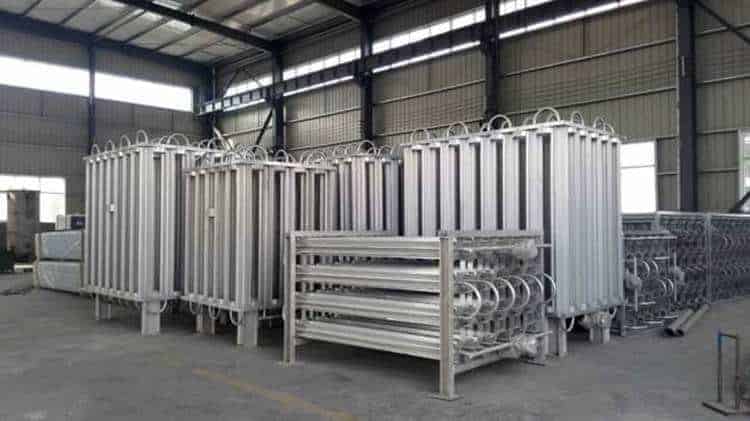


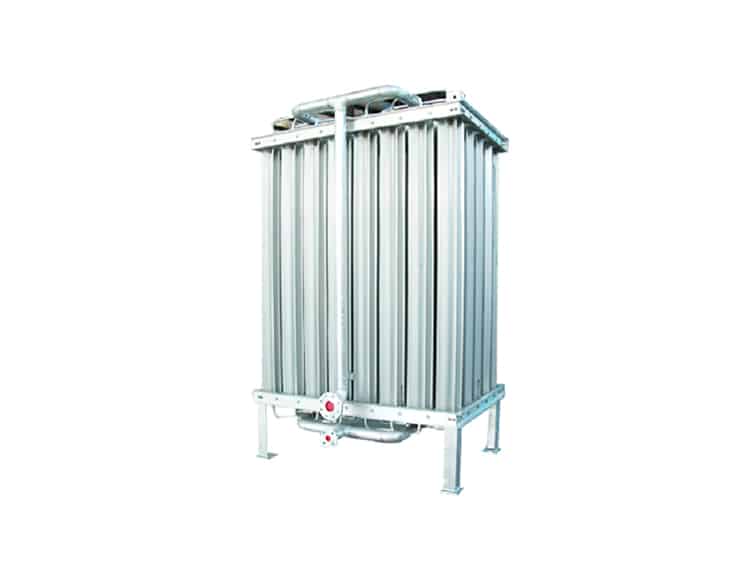

Description
Installation of Liquid Oxygen, Nitrogen, Argon, and CO2 Vaporizer Systems
Many users of liquid Oxygen, Nitrogen, Argon, and CO2 vaporizer systems have complained that the vaporization capacity of the system is insufficient when operating in winter, when the outside air temperature drops to 10-150C, leading to the vaporizer being completely covered in white frost.
The cold can also lead to freezing in the gas pipelines leading to measuring devices, pressure gauges, regulators, etc., which can damage these devices.
The question is whether the selection of the vaporizer’s vaporization capacity was correct, and what factors influence the selection of the appropriate capacity… The following article will answer such questions for customers.
Introduction to Vaporizers
High-pressure vaporizers are made from high-quality materials such as:
- Aluminum alloy tubes cast integrally with heat dissipation fins
- Cast stainless steel inner core
Structure: Aluminum alloy tubes cast integrally with heat dissipation fins, rigid frame, and stainless steel tubes.

Used in filling station systems for bottled gases and other high-pressure systems suitable for cryogenic liquefied gases such as: Liquid Oxygen, Liquid Nitrogen, Liquid Argon, and LNG, etc.
Standard vaporizers are manufactured according to ASME standards and can be modified according to other international standards such as BS, ADM & CE… depending on customer requirements.
- Lightweight and sturdy structure due to the entire system being made of aluminum alloy, long service life.
- Medium-pressure vaporizers, manufactured from high-quality materials including main materials such as: A6061 aluminum alloy tubes cast integrally with heat dissipation fins, capable of withstanding high pressure (up to 7Mpa).
- The main function of the vaporizer is to: conduct liquefied gas at a certain pressure and create a rapid heat exchange process through the heat dissipation fins when the liquefied gas at a temperature of (-1960C) passes through the equipment, the temperature will reach equilibrium with the ambient temperature.
- Vaporizer structure: Aluminum alloy tubes cast integrally with heat dissipation fins.
- Used in storage and distribution systems for cryogenic liquefied gases from -1960C to -400C such as: Liquid Oxygen, Liquid Nitrogen, Liquid Argon, Liquid CO2, etc.
- Simple and convenient to use and operate, long service life.
Applications of Vaporizers
- Used in filling systems for industrial gases, medical gases, and pure gases such as: Oxygen, Nitrogen, Argon, CO2, etc.
- Used in factories, enterprises, and medical centers. Different types of vaporizers are available depending on capacity, design, and intended use.
- Applied in high-pressure liquid pumping systems from liquid lines to storage tanks.
- Backup systems
- Commitment to continue gas distribution tasks
- Vaporizing exhaust gas
- Air blowing applications, etc.
The design of the vaporization capacity of ambient air vaporizers is based on the standard of Nitrogen gas under the following environmental conditions:
| Air temperature: | +200C |
| Relative humidity: | 70% |
| Difference between ambient temperature and vaporized gas outlet temperature: | +150C |
| Continuous operating time: | 8h |
This means that changes in the above standard conditions will lead to corresponding changes in the vaporization flow rate of the vaporizer.
Factors Affecting Vaporization Flow Rate
There are 3 basic factors that change the vaporization flow rate of the vaporizer:
- Continuous operating time factor
- Type of gas being vaporized
- Working environment factor, specifically the ambient temperature here.
- Each of the above factors needs to be assigned an appropriate adjustment coefficient. We will now consider the adjustment coefficient for each factor:
Continuous Operating Time Adjustment Coefficient (denoted as cd)
The following graph clearly shows how the continuous operating time of the vaporizer affects the gas vaporization flow rate coefficient.

- Curve 1 shows the daytime operation of the vaporizer in a well-ventilated area, outdoors in sunny or clear weather.
- Curve 2 shows the operation of the vaporizer without wind and in the shade.
Gas Type Adjustment Coefficient (cf)
The vaporizer design uses Nitrogen as the standard with a coefficient cf = 1. For other liquefied gases, we have the following adjustment coefficients:
| Gas Type | He | H2 | Ar | N2 | O2 | CH4 | CO2 (at 20 bar) |
| Cf | 1.87 | 1.29 | 1.11 | 1.0 | 0.88 | 0.75 | 0.8 |
Ambient Temperature Adjustment Coefficient (ct)
The design ambient temperature is 200C. With ambient temperature adjustments, we have the following adjustment coefficients:
| Ambient Temperature | -10 | – 5 | 0 | +5 | +10 | +15 | +20 | +25 |
| Ct of CO2 | -5 | 0.28 | 0.46 | 0.64 | 0.82 | 1.0 | 1.18 | |
| Ct of other gases | 0.70 | 0.75 | 0.80 | 0.85 | 0.90 | 0.95 | 1.0 | 1.05 |
Conclusion: Based on the above analysis, the actual vaporized gas flow rate of the vaporizer will be calculated using the formula: Factual = Fstandard x cd x cf x ct
Example: A vaporizer with a capacity of 100m3/h, used for vaporizing liquid Oxygen, operating continuously for 12h/day, under an average ambient temperature of 25 0C, will have a vaporization capacity of:
Factual = 100 x 0.88 x 0.88 x 1.05 = 81.3 m3/h
Migco Company specializes in providing vaporizers, converting liquid gases to gaseous form for industrial production. Products are distributed nationwide.
Contact now: 093 77 55 800
FAQ – Frequently Asked Questions about Vaporization
What is Vaporization?
Vaporization of an element or compound is a phase transition from the liquid phase to vapor. There are two types of vaporization: evaporation and boiling. Evaporation is a surface phenomenon, whereas boiling is a bulk phenomenon.
Distinguish between Vaporization, Evaporation, and Sublimation
Evaporation (or vaporization) of an element or compound is a phase transition from the liquid phase to vapor. There are two types of vaporization: evaporation and boiling. Evaporation is a surface phenomenon, whereas boiling is a bulk phenomenon.
Sublimation is the direct transition from the solid phase to the gas phase, without passing through the intermediate liquid phase. Because it does not involve the liquid phase, it is not a form of vaporization.


